

Crabgrass in Richmond Lawns: What You're Fighting
Crabgrass is a summer annual. It sprouts from seed in spring, grows through the heat, sets seed from July through September and dies after the first fall frost, which comes around November 4 in a typical Richmond year. Penn State says one plant can produce thousands of seeds. Virginia Tech weed scientists note that in Virginia it can germinate anywhere from March through August, a much longer season than one spring treatment covers.
Smooth and Large Crabgrass
Two species show up in lawns. Smooth crabgrass (Digitaria ischaemum) is the smaller one, with only a few long hairs near the base of the leaf. Large crabgrass (Digitaria sanguinalis), also called hairy crabgrass, has hairs on both sides of the leaf and on the sheath. Both spread low and flat, and their stems can root where they touch the ground. The control methods are the same for both.
Crabgrass Look-Alikes: Goosegrass and Nimblewill
Not every flat grass weed is crabgrass. Goosegrass has a whitish center and a wagon-wheel shape, doesn't root at the nodes and does well in compacted soil. NC State notes it sprouts at about 60 °F, usually two weeks or more after crabgrass, so an early pre-emergent can miss it. Nimblewill forms dense mats of thin leaves, often in shade. It's a perennial, not an annual, so a spring crabgrass preventer, which works on seeds, isn't the tool for an established patch, and NC State says selective control of perennial grass weeds is usually difficult.
Crabgrass Prevention: Timing the Pre-Emergent
A pre-emergent herbicide forms a barrier in the top layer of soil that kills crabgrass as it sprouts. It does nothing to plants already up. Virginia Cooperative Extension's cool-season calendar puts the spring window in March and April. Its cue is forsythia: the product should be down by the time forsythia starts to drop its blooms.
The trigger itself is soil temperature. NC State says crabgrass starts when the 24-hour average soil temperature holds around 55 °F for three or four days in a row. Virginia Tech's Hampton Roads research center uses 50 °F and advises treating in early March, since the date is hard to predict. In Richmond, forsythia is the easy signal to watch.
Active ingredients
Virginia Tech names dithiopyr, pendimethalin and prodiamine as the main pre-emergents for tall fescue home lawns.How long they last
About three months, and less in a wet spring, when the product breaks down faster.Split applications
Because crabgrass keeps germinating into August, Virginia Tech notes that some applicators put down half the rate in March and the second half in May or June.Water it in
Rain or irrigation has to move the product into the soil. Penn State says to water it in within two to three days, and North Dakota State gives half an inch of water as the amount needed.Skip the nitrogen
Virginia Tech prefers granular products without fertilizer, because cool-season lawns should get most of their nitrogen in fall. Virginia Cooperative Extension has also warned that extra spring fertility can injure tall fescue and lead to decline in the summer.
Pre-Emergent and Grass Seed: Pick One per Season
The standard crabgrass preventers, dithiopyr, pendimethalin and prodiamine, don't tell crabgrass seed from grass seed. Virginia Tech says they go only on established turf that's been mowed two or three times, never at seeding. After an application, Penn State says seeding has to wait as long as the label says, which can be up to six months. A March pre-emergent can rule out spring overseeding altogether.
There are exceptions. Penn State lists siduron and mesotrione as safe on new cool-season seedings, and Virginia Tech adds quinclorac as usable at seeding. They're shorter-lived in the soil, so they don't control crabgrass as long as the standard products. Virginia Tech weed scientists found siduron the most accepted choice for spring-seeded tall fescue.
The simpler route is to keep the two jobs in different seasons: pre-emergent in spring, seed in September and October, when Extension says cool-season grass establishes best. The calendar also shows a fall pre-emergent window for annual bluegrass, and that one has to be skipped wherever you plan to overseed. For seed choice, see our guide to the best grass seed for Richmond.
Killing Crabgrass That's Already Up
Once crabgrass is up, the goal is to hit it young. Dithiopyr is the one common pre-emergent that also kills very young seedlings. North Dakota State puts the limit at the one- to three-leaf stage, and Penn State at the first tiller. After that, it takes a post-emergent.
Plant size
Of the selective post-emergents Penn State lists for cool-season lawns, mesotrione and topramezone work best on plants with fewer than four tillers. Quinclorac controls both new and mature plants but can miss plants at the two- to four-tiller stage.Temperature
Weeds must be actively growing for a post-emergent to work, and Extension's calendar says warm-season weeds need 80 °F or more for the best control. Richmond's normal July high of 89.5 °F clears that easily.Late summer
By late July the plants are large. Purdue's advice, written for Indiana, is to stop spraying after mid-July and let frost finish them. In Richmond, treat in early summer while the plants are small, and plan to reseed in fall.
Read the label for the grasses it's safe on, the rate and any seeding restriction before buying. Virginia Cooperative Extension's guide to pesticide labels notes that the user may be liable if something goes wrong.
A Thick Lawn Is the Long-Term Crabgrass Fix
NC State's advice for crabgrass control is to keep the turf dense and actively growing. Thin stands, low mowing, summer fertilizer and light, frequent watering all give crabgrass the openings it needs.

Mow Tall Fescue at 3 Inches
In an NC State field trial in Raleigh, tall fescue mowed at 1, 2, 3 and 4 inches had 95%, 48%, 13% and 0% crabgrass cover by mid-September. Virginia Cooperative Extension recommends 3 inches for tall fescue.
Water Deep, Not Daily
Purdue's crabgrass guide says daily, light irrigation promotes shallow roots and encourages crabgrass. Extension's rule for Virginia lawns is about an inch of water a week from rain or irrigation, applied deeply in the early morning. If you have a sprinkler system on a daily timer, fixing that schedule is a crabgrass control step.
Feed and Seed in Fall
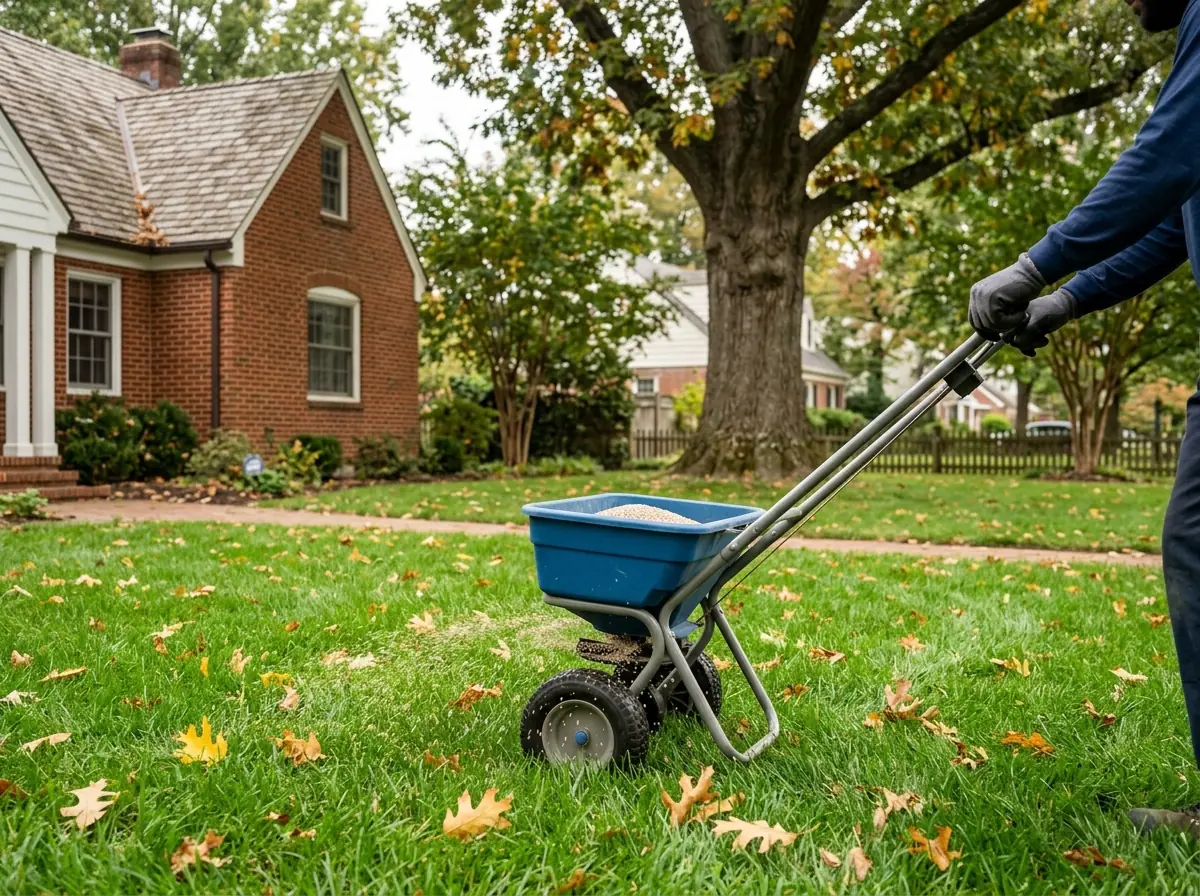
Virginia Cooperative Extension puts most of a fescue lawn's nitrogen in September, October and November, and the same months are the best seeding window. Aerating and overseeding the thin spots crabgrass exploited in summer leaves less open soil next spring.
Why Richmond homeowners call Richmond Elite Landscaping
- Free on-site estimate
- Scope, materials and price in writing before work starts
- Utility lines marked through VA 811 before digging
- One local landscaping contractor, not a call list
- No charge to homeowners for the referral
Hiring Crabgrass Control in Richmond
Anyone who applies herbicides for pay in Virginia needs a commercial applicator or registered technician certification from the state. Before you sign up for a program, ask two questions: which active ingredient goes down in spring, and will it block any seeding you're planning? We pass your request to one independent local lawn care contractor, who quotes and does the work.